“History shows us that progress has never been a straight line; it moves in cycles, advancing and retreating.” – Interview with Stuart Eggleton and Joseph Winer of ‘Solomon’

On Thursday, 23 April, Manchester Jewish Museum will host ‘Solomon’, a new biographical solo play written by Stuart Eggleton and directed by Joseph Winer.
The play tells the extraordinary story of Simeon Solomon, a brilliant, boundary-pushing queer Jewish artist at the heart of the Pre-Raphaelite movement. From his meteoric rise in the art world to the public scandal that shattered his career, Solomon’s story is both inspiring and devastatingly relevant.
Along the way, he encounters some of the era’s most celebrated figures, including Edward Burne-Jones, Henry Holiday, and Algernon Charles Swinburne, as he reflects on love, belief, and what it truly costs to live honestly.
“Solomon” premiered at Camden People’s Theatre as part of the Tsitsit Jewish Fringe Festival (2023). Since then, it has been further developed with The Royal Academy of Art and toured to venues including JW3, Stanley Arts, Cambridge University, and Seven Arts Leeds.
And this month we’re thrilled to bring it to Manchester.
Ahead of the show, we spoke to Stuart and Joseph about the incredible story behind this play.
Hello Stuart and Joseph! We’re very excited to host “Solomon” at Manchester Jewish Museum! Before we talk about the play, could you please introduce yourselves and tell our audiences a little bit more about your work?
Stuart (S): Hi, my name is Stuart Eggleton. I’m a playwright and writer, and I often write about queer characters who I have been forgotten had an intriguing past.
Joseph (J): My name is Joseph Winer. I’m a theatre director who mainly works on the development and production of new plays. Much of my work explores queer characters and stories, and I’m particularly interested in ideas around legacy: how stories are passed on, and how queer people from history who have been forgotten or overlooked can be rediscovered and celebrated.
What first drew you to the story of Simeon Solomon, and why did you feel his life was important to bring to the stage today?
S: I’ve studied art and been interested in it all my life, and yet I knew nothing about Solomon. I came across him in an article when I was looking for something else at the British Library. I was really saddened that I didn’t know who he was. When I started researching him and reading about his life, I discovered that this near-genius became destitute. While researching the play, I found more of his work, and the more I saw, the more interested I became in him. It was fascinating to see him and understand where he was placed within Victorian society.
J: I was really drawn to Simeon Solomon as a gay Jewish artist whose story isn’t widely known today. He was effectively ostracised by many of the people around him because of his sexuality, and I felt there was something important about bringing that story to audiences now. As a queer Jewish artist myself, I felt a strong sense of connection with him and a desire to help share his story.

The play explores both Jewish identity and queerness in Victorian society. How did you approach balancing the historical reality with making the story resonate for contemporary audiences?
S: I think Solomon’s story has a human element to it: a great fall because something natural to him goes against society’s norms. That can apply to anyone, something we can all be frightened of for ourselves or for others. Telling his story, and the pleasure and pain he went through, is what I hope will connect with audiences. Queer identities in a historic context are particularly interesting to examine at this moment in time, as LGBTQ+ rights are being narrowed and questioned. History shows us that progress has never been a straight line; it moves in cycles, advancing and retreating.
J: One of the things that interested me was how we could make Solomon’s story feel immediate and relevant to audiences today. Working with Stuart, we’ve tried to remain as historically truthful as possible while also creating something theatrically exciting and emotionally engaging. Finding that balance between accuracy and dramatic energy has been a really exciting part of developing the piece. In many ways, we didn’t need to force that connection. The struggles Solomon experiences around identity, family relationships and sexuality still feel very recognisable for many queer and Jewish people today. Because those themes remain so relevant, audiences naturally connect with them, which is part of what makes his story so powerful on stage.
If you had to describe Simeon Solomon in three words, what would they be?
S: Genius, misunderstood, Pre-Raphaelite
J: Passionate, Artistic, Tragic
What do you hope audiences will take away from the play?
S: I love when audiences get up and they look at his pictures after and I hope anyone would want to learn more about his artwork rather than his very sad life.
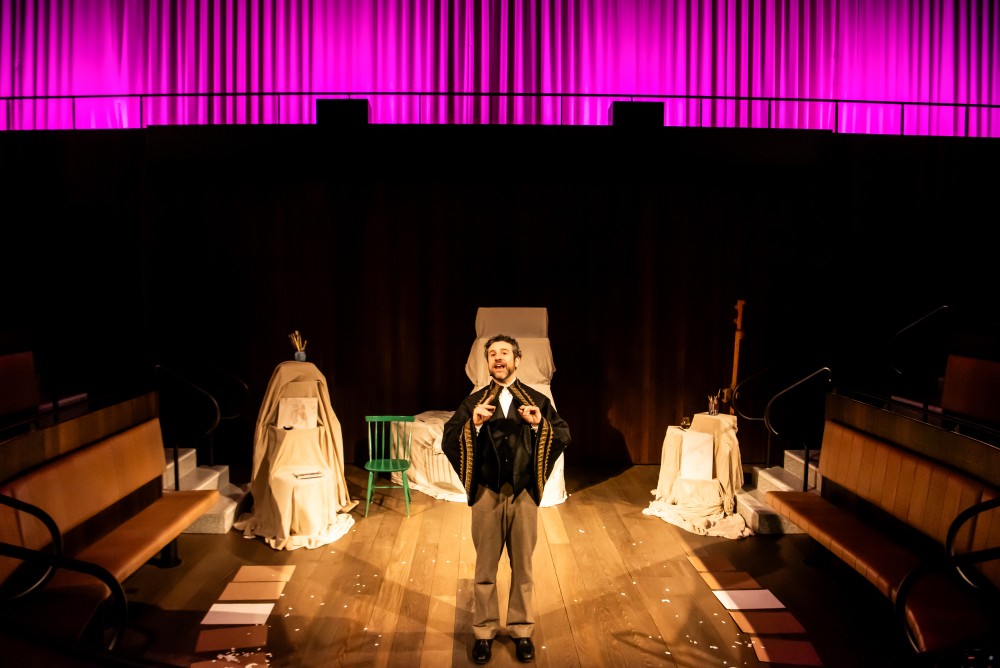
J: I hope audiences come away having learned about Simeon Solomon and feeling a sense of the injustice of what happened to him. At the same time, I hope they feel entertained; it’s a gripping and exciting piece of theatre, beautifully performed by Jonathan Forrester, and we want audiences to be both moved and engaged by the story.
What excites you most about bringing this story to Manchester and to our museum?
S: We’ve never done the show in Manchester before and we’re bringing it to such a beautiful venue and there is a connection with Solomon and Manchester. Later on in Solomon’s life, when he was homeless, he used to have a dealer who used to try to sell his artwork to the merchants in Manchester. So a lot of his work ended up around Manchester!
J: A big aim of the project has been to take the show to audiences around the country rather than keeping it London-centric. It’s really exciting to share Solomon’s story with Jewish and queer audiences in Manchester, and performing it in the beautiful synagogue at Manchester Jewish Museum feels particularly meaningful.