Manchester Jewish Museum

News

Go Back

Corten and the new museum

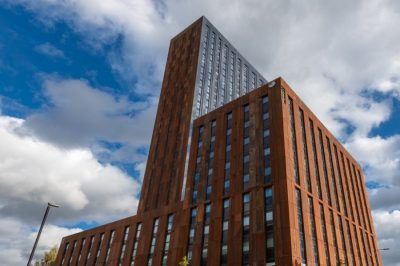
MJM Exterior – Jan 2021

You may have spotted the rust-coloured façade of our new museum extension if you’ve driven down Cheetham Hill Road recently, but what is it? Surely the multi-million pound extension hasn’t rusted before it’s even opened?

The answer is Corten (also called COR-TEN, aka ‘weathered steel’). This beautiful copper-coloured material is the corrosion resistant cladding on our new extension, etched with intricate and ornate patterns (more information on our designs and their inspiration to come). Designed by our architects, Citizens Design Bureau, the corten beautifully compliments the slate roofing and red brick of our original 1874 synagogue building.

When compared to other steels, corten has a unique chemical composition that means it is resistant to weather conditions like rain, frost, sun and snow. When exposed it forms a protective layer which looks like rust, giving it it’s aesthetic quality, but is actually an ‘oxidation layer’.

With its contemporary looks, whilst simultaneously recalling Manchester’s proud industrial heritage, we hope our new museum provides an exciting addition to Manchester’s architectural landscape.

But we’re not unique in using Corten. Here are our top 5 Corten buildings in Manchester:


1) People’s History Museum

Top of our list has to be our friends at People’s History Museum with their corten clad building located at the edge of Spinningfields. This museum is the home of ‘ideas worth fighting for’, and the only museum in the UK dedicated to the history of British democracy. Photo from Peoples History Museum.

2) Parkway Gate

Next on our list has to be Manchester’s first corten building. Parkway Gate, designed by Ian Simpson, is a striking part of Manchester’s skyline with three large student accommodation buildings. Photo by Simon Glyn, 2009.

3) Ordsall Chord Railway Viaduct

Constructed in 2018, the BDP designed Ordsall Chord spans the River Irwell connecting the twin cities of Manchester and Salford. The undulating corten makes for an underappreciated Manchester landmark. Photo by Matthew Nichol Photography.

4) Hallé St Peter’s

Described as Ancoats’ ‘grace and beauty’ (Manchester Confidential), Hallé St Peter’s blends seamlessly with the red brick heritage of Ancoats as it houses part of Manchester’s most established cultural history: The Hallé Orchestra. Photo from Manchester Evening News.

5) River Street Tower

Finally we have River Street Tower, the tallest of Manchester’s Corten structures (and perhaps the most controversial). This student accommodation tower stands at 92 metres (302 feet) high, situated by First Street, just north of the Mancunian Way. Photo from Downing Students.

PREVIOUS NEWSSEE ALL NEWS

“History shows us that progress has never been a straight line; it moves in cycles, advancing and retreating.” – Interview with Stuart Eggleton and Joseph Winer of ‘Solomon’

On Thursday, 23 April,  Manchester Jewish Museum will host 'Solomon', a new biographical solo play written by Stuart Eggleton and directed by Joseph Winer. The play tells the extraordinary story of Simeon Solomon, a brilliant, boundary-pushing queer Jewish artist at the heart of the Pre-Raphaelite movement. From his meteoric rise in the art world to the public scandal that shattered his career, Solomon’s story is both inspiring and devastatingly relevant. Ahead of the show, we spoke to Stuart and Joseph about the incredible story behind this play.

Our Chanukah Appeal: Help us continue to bring people together!

The entire museum Team wishes you and your loved ones a restful holiday season and a bright, joyful Chanukah. We are deeply grateful for your support over the past year. As a registered charity, we rely on the generosity of our members, supporters and partners to be able to bring our work to life. We believe that our work is needed now more than ever, but we need your help to continue our mission and grow our impact.

“Sara Wesker may have lived 100 years ago but her story is definitely a “Play For Today”.” – Interview with Lottie Walker

On May 1st, International Workers’ Day, Manchester Jewish Museum will host a performance of “Chopped Liver and Unions”, a one-woman play which tells the remarkable but largely forgotten story of Sara Wesker, a trailblazing trade unionist who led the “singing strikers” of 1928, stood on the barricades at Cable Street, and fought tirelessly for East End garment workers. Ahead of the show, we spoke to performer Lottie Walker about the incredible story behind this play.